
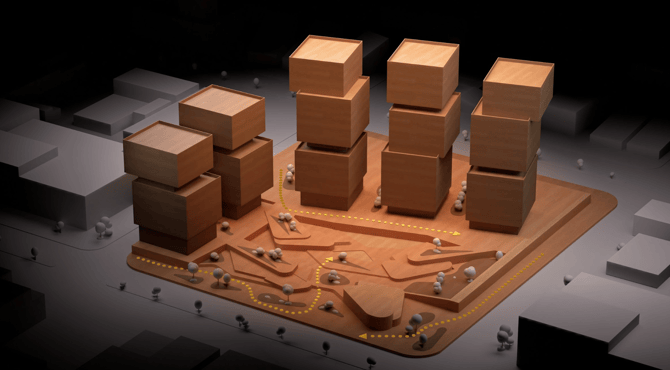
Meet Axogram, our new plugin created specifically for architectural diagramming.
Working directly alongside your CAD application, Axogram lets you transform your live 3D model into clear, expressive diagrams using visual styles, material overrides, annotations, arrows, zones, 3D text, and other communication tools.
Learn all about getting started, system requirements, compatibility and access in the articles below:
- Knowledge Base: What is Axogram and how do you get started?
- Knowledge Base: How do you download and access Axogram?
- Knowledge Base: What kind of computer does Axogram need?
Release Notes
September 15, 2026
Axogram is an evolution of (the now discontinued) Lumion View, however it has been completely reimagined and redesigned from the ground up with new features, settings, and improvements. See the list of changes below:
New Features and changes
1. Fully separate plugin
No longer bundled with or tied to Lumion %%LiveSync%%. Axogram and %%LiveSync%% now run as two distinct tools inside SketchUp, Revit, and Archicad, so you choose Axogram for diagramming and %%LiveSync%% for continuing into Lumion Pro.
2. Completely redesigned UI
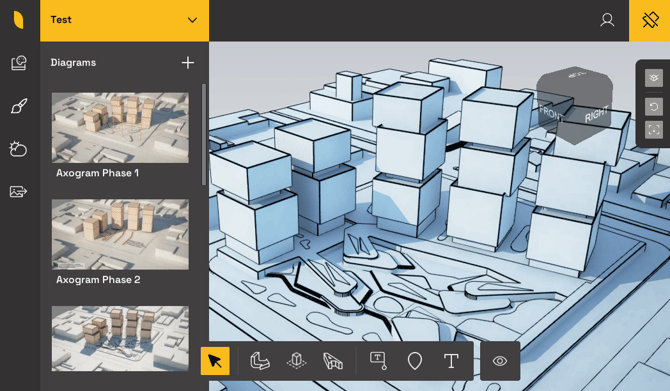
Axogram introduces an entirely new visual identity, distinct from Lumion Pro and the old Lumion View, built around a purpose-made design system:
- New sidebar layout (Main modes now live in a sidebar similar to Lumion Pro's structure, but restyled for Axogram's own look and feel)
- New typography
- New brand identity and logo
- Rebuilt secondary interfaces (The %%Environment%% tab was redesigned with a cleaner layout and gradient support and the rendering panel was reorganized all in the new visual language.)
3. Create and manage diagrams
Create multiple %%Diagrams%% (3 on the free version, unlimited on Paid) from the same CAD model without duplicating or altering the source model. You can:
- Create, duplicate, rename, reorder, and delete %%Diagrams%%.
- Save and revert the camera position for each %%Diagram%%.
- Update %%Diagram%% thumbnails automatically.
- Give each %%Diagram%% its own camera, %%Style%%, %%Environment%%, %%Annotations%%, and more.
- Return to your %%Diagrams%% across working sessions.
This makes it possible to develop several views, stories, and presentation %%Styles%% from a single design. %%Environment%% settings are saved separately for each diagram, allowing the same model to be presented under different lighting conditions.
4. Diagrammatic Styles
Quickly define the visual language of a diagram using a selection of ready-made Diagrammatic %%Styles%%.
Styles can change the overall treatment of the model, including:
- Colors and tinting.
- Surface appearance.
- Edge visibility and color.
- Shadows.
- Texture scale.
- Visual effects such as noise and linework.
Each %%Style%% can be adjusted to create anything from a clean technical drawing to a softer conceptual presentation.
5. Style Mixer
The %%Style Mixer%% gives you more control over the appearance of individual materials and parts of your design.
Use it to:
- Identify %%Materials%% by clicking on surfaces.
- Select %%Material%% groups directly from the model.
- Highlight every object using the selected %%Material%%.
- Apply different colors and diagrammatic textures.
- Add or adjust edges for selected materials.
- Review and manage previously styled materials.
%%Style Mixer%% settings are saved between sessions, allowing you to continue refining the visual treatment of your project later.
Learn more about customization, diagrams, and rendering in the article below:
-
Knowledge Base: How do you customize and render a Diagram in Axogram?
6. Rebuilt Fly/navigation experience
Acrosshair now appears when moving with WASD, right-click-drag lets you orbit around any point on the model, movement carries a touch of inertia for smoother flying, and camera sensitivity is faster overall.
You can see all navigation Keyboard Shortcuts below:
- Knowledge Base: Keyboard Shortcuts in Axogram
7. Annotations
It is now possible to add information directly to your model using customizable %%Annotations%%.
Annotations can include:
- Labels and descriptions.
- Leader lines.
- Pin markers.
- Icons and pictograms.
- Custom fonts, colors, and text sizes.
- Bold and italic text.
- Adjustable backgrounds, outlines, and transparency.
Annotations belong to the %%Diagram%% in which they were created, so each %%Diagram%% can communicate different information without affecting the others.
8. Action Shapes and Zones
Use %%Action Shapes%% to explain movement, circulation, relationships, areas, and design intent.
Available tools include:
- %%3D arrows%%
- %%Flow Lines%%
- %%Zones%%.
- Circles and directional endpoints.
- %%3D Text%%
You can add, move, edit, and remove individual nodes, with snapping support for more precise placement.
%%Zones%% provide real-time drawing feedback and a preview of the next node, helping you create areas more accurately.
You can learn more about all the new %%Action Shapes%% and %%Annotation%% objects in the toolbar from the article below:
-
Knowledge Base: How do you annotate diagrams in Axogram?
9. Exposure slider
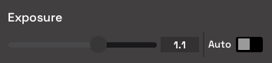
In the %%Environment%% tab, you can now disable %%Auto Exposure%% and adjust it manually using the slider.
10. Gradient Backgrounds
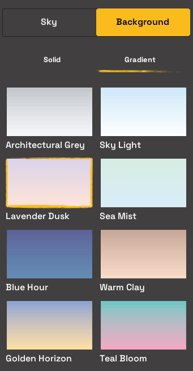
Aside from the %%Sky%% and %%Solid%% colors, there are now 8 different gradient %%Backgrounds%% to choose from:
11. Lumion Cloud AI enhancer integration
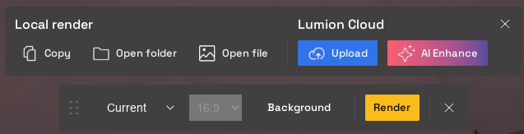
The finished render menu now has an %%AI Enhance%% button. Clicking the button will quickly upload the render and take you to the Lumion Cloud enhancer screen.
Moving from Lumion View
For information about Axogram access, Lumion View availability, and moving to the new plugin, see:
- Knowledge Base: From Lumion View to Axogram
See Also:
-
Lumion Website: Axogram product page
-
Lumion News: Lumion launches Axogram